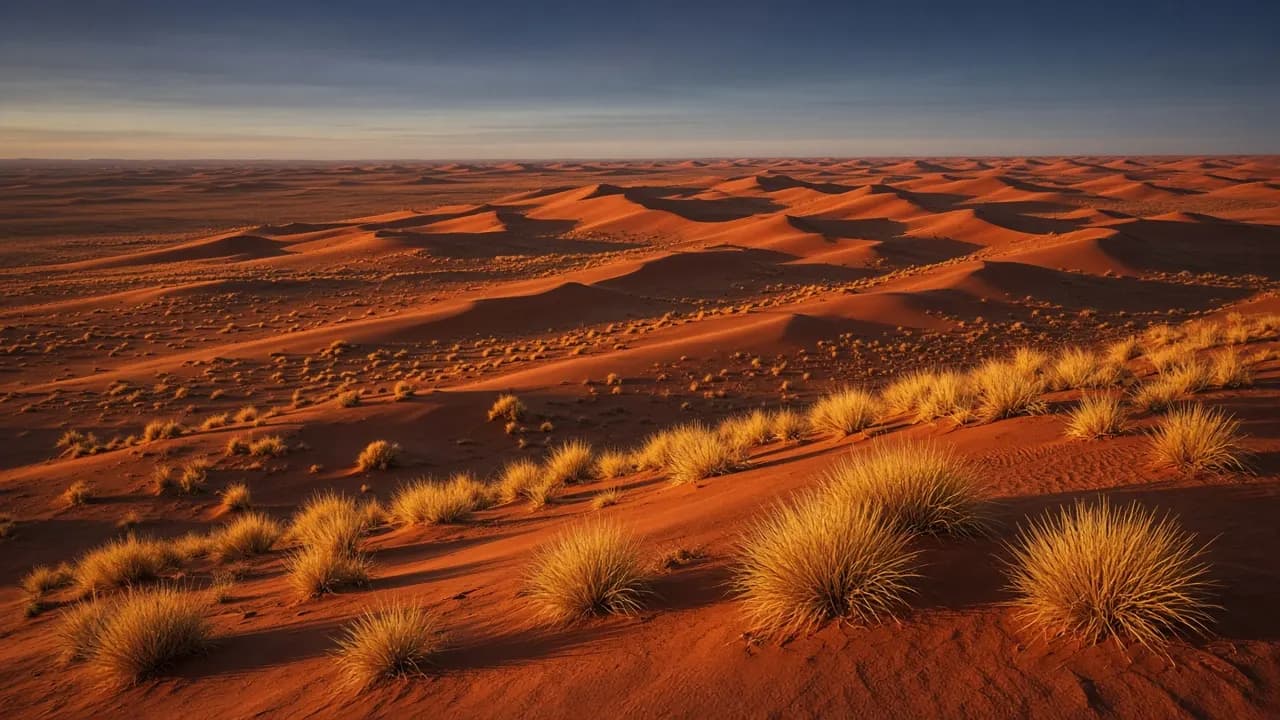
A desert crossing is a logistics exercise that happens to be beautiful. The dunes and the night sky are why people go. The reason people get into trouble is almost never a lack of scenery. It is a missing permit at a boundary, a water plan that assumed a well, or a heat decision made at noon because the morning felt fine.
This page answers the permit question first, because that is the question, and then stays with the way desert country treats a vehicle.
The Simpson: three doors, not one
The Simpson Desert as travellers mean it — a west–east or east–west run across the dune fields — is not a single park. It is a meeting of desert reserves managed by different governments.
- South Australia. National Parks and Wildlife Service South Australia administers desert parks on the SA side and publishes the access product and conditions that apply there. If your route uses those parks, that desk is mandatory reading.
- Queensland. Queensland Parks and Wildlife Service administers Munga-Thirri / Simpson Desert country on the Queensland side. A Queensland park permission is a Queensland park permission.
- Northern Territory. NT Parks and Wildlife administers the Territory desert parks that sit on some crossings. Again: a separate door.
Plan the actual line on a map and list the parks you will sleep in, not the parks you have heard of. Then open each authority’s current page. If a page describes a seasonal closure, a one-way recommendation, a camping rule or a fire restriction, that is the rule for that ground.
Do not expect a pass bought for one state to be honoured as a courtesy in the next. Courtesy is not how park finance or park law works.
Other desert crossings — the Madigan, survey tracks, and lines that only clip the dune field — follow the same stack-the-tenures method. The name of the track is not the name of the permit.
The Canning: permissions are the route
The Canning Stock Route is longer, thinner, and more obviously a cultural landscape. It is not “a Western Australian park drive” with a side of history. It crosses Aboriginal land whose managers decide who camps, where, and on what terms. It also touches reserves and other tenures that have their own notices.
There is no honest way to write a single permit sentence for the whole Canning. The honest way is:
- List the camps and wells you intend to use.
- Identify the prescribed body corporate, land council or other landholder for each.
- Apply for what those bodies actually issue, in the window they ask for.
- Add any DBCA or other Western Australian reserve requirements that sit on your line.
- If a permission is not in hand, change the line.
If that sounds slower than a highlight film, it is. The Canning is not improved by arriving at a community or a closed gate with a shrug.
What desert parks will not sell you
They will not sell you water. Some wells and tanks exist; some are unreliable; some are not for visitors. Plan drinking water as if the next named source is dry. The trip preparation guide is where that maths belongs.
They will not sell you cooler weather. Desert managers close or discourage travel when heat makes a mechanical delay life-threatening. Believe them. A “we will travel early and rest” plan is still a heat plan, and it still needs a beacon and a home contact as described in remote-area safety.
They will not sell you a recovery. Dune country is soft, corrugated on the crossings, and far from a tilt-tray. Boards, a shovel, rated points and a second vehicle are the recovery basics with more sky around them.
Dune driving without mythology
A dune has a back and a face. The face can drop away in a way a windscreen does not show. Walking a blind crest is not timid. It is how you avoid meeting another vehicle or a hole at the worst possible moment.
Tyre pressures follow the same physics as the beach: a longer footprint floats. The desert adds heat in the tyre and heat in the engine. Air down for the sand you are on, watch temperatures when you are working a vehicle hard at walking pace, and air up when you return to harder, faster roads.
Momentum is useful and over-trusted. The useful version is a committed, straight, well-chosen line. The unhelpful version is a run-up that turns a mistake into a long walk for boards. If a dune looks wrong, stop at the bottom and pick another gap. The desert has more dunes.
Travel with at least one other vehicle unless you have a specific reason and the communications to match a solo delay. Isolation is the Simpson’s actual personality.
Camps, fires and the wind
Camp where the permit allows, not where the sunset is nicest on a dune that is also a road. Desert wind moves sand into everything you left open and moves fire further than a still evening suggests. Fire restrictions on desert park pages are not a vibe. They are how a travelling stove relates to a spinifex year.
Take the rubbish. The myth that “the desert hides it” is how the desert collects it.
A permit-day checklist
The morning you leave the last town:
- each jurisdiction’s access is paid or issued, and an offline copy is in the vehicle
- the land-council or PBC permissions for a Canning-style line are in the same folder
- water is actually in the vehicle, not on a list
- the PLB is registered and findable
- the home contact has the line and the silence time
- the park conditions page has been refreshed, not remembered
If any item is missing, the desert will still be there in a week. That is the only ranking this site will offer: a complete permit folder beats an early start.
Convoy manners in open country
Desert crossings are often travelled as two or more vehicles for the obvious recovery reason. That does not make the line a race. Agree a spacing that still lets the vehicle behind see a hand signal or a UHF call before it commits to the same dune. Agree who walks a crest. Agree that the first vehicle to have a problem owns the stop — the others do not roll on for “a better camp”.
Dust is a form of communication. If you cannot see the vehicle in front, you are too close or they are too fast. Either way, the next crest is a poor place to discover it.
Night driving in dune country is a specialist choice, not a way to make up time. Stakes, washouts and the odd animal do not advertise. If a delay has pushed you past the camp you named in the intention, send the change and stop at the next honest flat, not at the camp you can no longer reach without guessing.
What a well looks like on a map
Named wells and historic stock-route infrastructure are part of why people come. They are not a water plan. Some are dry, some are reserved, some are culturally constrained, some are simply not the picnic the name suggests. Read the land-manager notes for the well you hoped to use. If those notes are silent, carry the water anyway.
The same caution applies to “there will be other travellers”. In a popular week there may be. In a shoulder week there may not. Design the communications and the water for the empty version of the map.
Borders, biosecurity and the unglamorous extra pages
State borders in desert country can still carry biosecurity or fruit-and-plant rules, and some reserves ask for a clean-down so that weeds do not hitch a ride in a chassis rail. That is not a slight on your housekeeping. It is how a spinifex plain stays itself. If a page asks you to arrive clean, arrive clean.
Do not bury waste. Do not cut new pad. Do not assume a drone is welcome because the sky is big. If a land manager has published a rule about any of those, it applies in the emptiness just as it would in a crowded campground. The desert looks empty. It is not unowned, and it is not a bin.
Desert crossings reward people who treat borders as real. Collect the permissions, carry the water, and let the dunes be the part you did not try to bargain with. The iconic tracks page places these routes among the others; this page is the one to print beside the permit confirmations.
Questions people ask first
Each answer leads with the useful part, then the caveats that belong with it.
- Do I need permits for desert crossings (Simpson, Canning)?
- Yes. The Simpson crossing typically needs the current desert-park access for each state or territory you enter — South Australia, Queensland and the Northern Territory have separate systems. The Canning Stock Route needs permissions from the Aboriginal-land managers along the route, plus any Western Australian reserve requirements on your line. Check each issuer; do not assume one pass covers the corridor.
- Does a South Australian desert parks pass cover Queensland or the Territory?
- No. Treat each jurisdiction as its own desk. If your crossing touches three systems, you are collecting three permissions — or choosing a route that stays inside the ones you have.
- When is desert travel sensible?
- Desert parks and land managers publish seasonal advice and closures because summer heat and extreme weather are not a scenery problem. Read the current notice for the parks you will enter rather than treating a calendar month as a guarantee.
- What is different about dune driving?
- Dunes ask for tyre-pressure technique, a reading of the slip face before you commit, and the discipline to walk a blind crest. They do not ask for a race. Recovery boards and a second vehicle’s rated strap are more useful than a speech about momentum.
Keep reading
- Iconic 4WD tracks
Cape York, the Canning, the Simpson, the Gibb, K’gari and the High Country — what makes each route distinct, and which authority to ask before you go.
- Trip preparation
How to ready a 4WD for remote travel: inspection, loads, water, fuel planning, and the paperwork park managers actually check.
- Remote-area safety
PLBs, satellite phones, trip intentions and heat. Communications that work when the mobile network does not.