A recovery is a small engineering problem that happens when people are hot, embarrassed and being watched. That is why the same handful of mistakes repeat: a strap on a tow ball, a person standing where the line would go if it broke, a winch cable used as a suggestion, a second attempt that is only a harder version of the first.
This page stays with the basics that keep a stuck 4WD from becoming an injury. It is not a product round-up and it will not tell you which brand to buy. It will tell you what a piece of kit is for, and when to put it back in the bag.
The order that avoids most recoveries
Before you reach for a strap, change the problem.
Read the surface. Sand wants a longer footprint — that is a tyre-pressure conversation, covered in the beach and desert guides. Mud wants you not to polish a hole into a deeper hole. Rock wants you not to break a sidewall proving a line that had an alternative.
Unload the drama. Passengers out, on firm ground, well away from the vehicle’s path and the eventual line. A recovery is not a spectator sport.
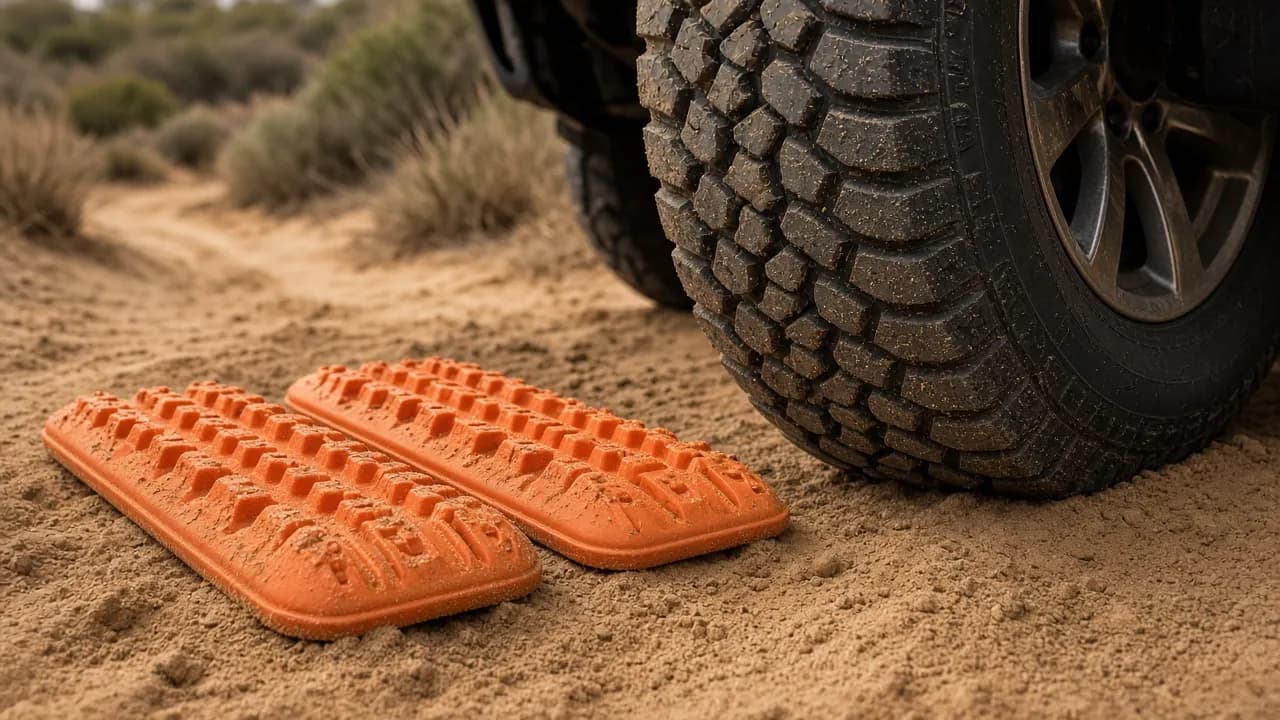
Clear and pack. A shovel and boards solve more afternoon delays than any winch montage. Pack boards under the driven wheels so the tyre can climb something with texture. Do not bury the first board and then invent a second theory.
Try the easy exit. Reverse out the way you came if that path is still honest. A 4WD is not obliged to continue forward to protect a plan.
If those moves free the vehicle, you had a delay. If they do not, you have a recovery.
Rated points, or do not pull
The vehicle must have somewhere safe to attach a load. Factory recovery points, or aftermarket points installed to the vehicle’s structure and identified as recovery points, are that somewhere. Bumper holes with no rating, tie-down loops, roof-rack eyes and tow balls are not.
A kinetic strap stores energy. That energy has to go into moving the vehicle or it will go into whatever failed. When a tow ball fails, it does not fail politely. If you remember one hardware rule, make it this: if it is not rated for recovery, it is not in the chain.
Soft shackles and rated bow shackles each have their place. What they share is a duty to match the strap and the point. Mixing mystery hardware because it “fitted” is how people collect stories they should not have.
Straps and the line
A snatch strap — more accurately a kinetic recovery strap — is for a rolling pull between two vehicles that both have rated points. It is not a tow rope for a dead vehicle on the bitumen, and it is not a winch extension unless the manufacturer explicitly says so.
Use it like this, in spirit if not as a ritual:
- both drivers already agree who pulls, how far, and what the stop signal is
- attachments are rated and seated
- a damper sits on the strap so that a failure has something to carry besides air
- nobody stands beside, over or in front of the line
- the pull starts with slack taken up, then a controlled stretch, not a hero run-up
- if the stuck vehicle does not move in a way that looks like progress, stop and change the setup
A long, hard pull that only digs the stuck vehicle deeper is not commitment. It is a new hole.
Equaliser or bridle arrangements exist for vehicles with two points. They are not an excuse to invent geometry with random rope. If you have not practised a bridle, do not learn it while a wheel is buried and the sun is going.
Boards, shovels and the unfashionable kit
Recovery boards give a tyre a ramp and a texture. They work in sand, in many muds, and as a packer in odd ruts. They need a shovel to be fully useful, because a board on a glazed hole is just a longer way to stay stuck.
A high-lift jack can be a powerful tool and a famous injury. If you carry one, you also carry the training and the stable base it demands. If you do not, boards and a second vehicle will still get most crews home.
Gloves belong in the same bag as the strap. Wire, burrs and hot recovery gear are not theoretical.
Winches
A winch is a way to move a vehicle when there is no second vehicle in the right place, or when the exit is a slow, controlled creep rather than a kinetic tug. It is also a way to hurt people if the cable or rope is damaged, if the recovery point on the far end is a tree without a protector, or if the operator has never run the winch under a calm load at home.
If you carry a winch:
- know how to use the clutch, the remote, and the fairlead
- inspect the rope or cable before the trip, not after the first bind
- use a tree protector on living timber, and pick an anchor that will not become the next problem
- use a damper
- keep the crew out of the line and out of the path the vehicle will take if it jumps
- motor care matters — winches heat up when they are working, and heat is a limit
A winch does not make a bad line good. It makes a good line possible when you are alone.
People, signals and pride
The most important recovery tool is the person who is allowed to say stop. Give that job to someone who is not the driver of the stuck vehicle. Agree hand signals before engines are loud. If two vehicles cannot see each other, do not guess — walk, or use radios.
Pride is how a shallow bog becomes a rolled vehicle. If the next attempt requires more energy rather than a better angle, better packing, or a different exit, you are no longer recovering. You are betting.
After the vehicle is free
Stop on firm ground. Look at the tyres, the points you pulled on, the strap and the steering. A recovery can hide a cut sidewall or a shifted bumper until the next corrugations. Reset tyre pressures when the surface changes. Thank the other crew without turning their help into a convoy obligation they did not offer.
If you used a winch rope, respool it under load later so the next recovery does not start with a bird’s nest.
Different surfaces, same rules
Sand wants pressure and boards. A beach or a dune that has already been driven can still hide a soft patch where someone else spun a hole. Pack the hole, do not polish it. If the vehicle is high-centred on a crest, digging the belly out is often more useful than a harder pull that only drives the chassis onto the sand.
Mud wants you to stop making it smoother. A second gentle attempt on a new line beats a tenth attempt in the same glaze. If the country is a park after rain, remember that the High Country and forest managers close roads because this exact behaviour destroys them. A recovery that requires you to leave the formed road is a recovery you should not complete by making a new road.
Rock wants patience and a spotter who can see the line the driver cannot. A strap that yanks a vehicle onto a step can break a sidewall or a diff in a way that walking the line would have avoided. If you do not like the next tyre placement, change the placement. The rock will not negotiate.
Snow and alpine clay sit in the same family as mud with worse consequences for a roll. If a High Country recovery is happening on a bench with a drop, the “people out of the line” rule includes people out of the fall line as well.
Kit that pretends to be recovery
Unrated straps in supermarket packaging, shackles with no working-load marks, and “recovery” holes cut into a bumper by optimism are how ordinary delays become projectiles. If you inherited a vehicle with mysterious hardware, assume it is innocent until a rating says otherwise. Replacing a point is cheaper than explaining a failure.
Exhaust jacks and other specialist tools have their users. They also have failure modes that do not belong in a first remote trip. Master the shovel, the board, the rated strap and the decision to stop before you collect exotic kit for its own sake.
A second vehicle is kit. Travelling with one is the most effective recovery upgrade most crews will ever make, provided both vehicles have points and both drivers have already had the conversation about signals.
Recovery kit is how you keep a remote trip boring in the right way. Carry less theatre and more rated, understood tools. The trip preparation guide is where that kit gets a place in the vehicle. The landscape guides are where you learn why sand, mud and snow each ask for a different first move.
Questions people ask first
Each answer leads with the useful part, then the caveats that belong with it.
- What recovery gear should I carry and how is it used safely?
- Carry rated recovery points, a kinetic strap used only on those points with a damper, recovery boards, a shovel and gloves. Use the least force that frees the vehicle, keep people away from the line, and stop if an attachment or the country looks wrong. A winch is optional extra capability for some trips.
- Can I use a snatch strap on a tow ball?
- No. A tow ball is not a recovery point. Kinetic loads can turn a ball into a projectile. Use rated recovery points or a properly installed recovery hitch designed for that job.
- Do I need a winch for Cape York or the desert?
- Many well-driven trips on famous routes never use a winch. Boards, tyre pressure and a second vehicle’s rated strap solve more bogs than people expect. A winch earns its weight on solo-ish travel, steep or one-way exits, and country where a second vehicle cannot line up. It is a tool you must already know how to use.
- What does “rated” actually mean?
- It means the point, shackle or strap is manufactured and identified for a recovery load, and fitted to the vehicle as the maker intended. If you cannot find a rating, treat it as decoration.
Keep reading
- Trip preparation
How to ready a 4WD for remote travel: inspection, loads, water, fuel planning, and the paperwork park managers actually check.
- Beach driving
Tyre pressures, tides and vehicle access permits — where to confirm the rules before you drop onto the sand.
- Desert crossings
Simpson and Canning country: multi-tenure permits, dune driving, and why park and land-council notices sit above any trip report.